
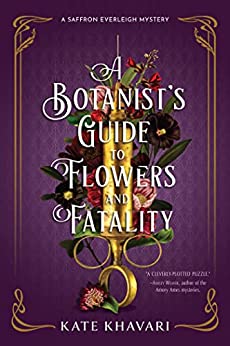
Hello all! I am pretty excited to be reviewing A Botanist’s Guide to Flowers and Fatality by Kate Khavari because the fourth book in the series is coming out this June, and I loved getting the opportunity to browse through this second book and remember how much I love this series. Having reviewed the first in the series, A Botanist’s Guide to Parties and Poisons, a while back, I can say book 2 is just as amazing. Without further ado, thank you Netgalley and Crooked Lane Books for this (very belated) opportunity!
From the Publisher:
1920s London isn’t the ideal place for a brilliant woman with lofty ambitions. But research assistant Saffron Everleigh is determined to beat the odds in a male-dominated field at the University College of London. Saffron embarks on her first research study alongside the insufferably charming Dr. Michael Lee, traveling the countryside with him in response to reports of poisonings. But when Detective Inspector Green is given a case with a set of unusual clues, he asks for Saffron’s assistance.
The victims, all women, received bouquets filled with poisonous flowers. Digging deeper, Saffron discovers that the bouquets may be more than just unpleasant flowers— there may be a hidden message within them, revealed through the use of the old Victorian practice of floriography. A dire message, indeed, as each woman who received the flowers has turned up dead.
Alongside Dr. Lee and her best friend, Elizabeth, Saffron trails a group of suspects through a dark jazz club, a lavish country estate, and a glittering theatre, delving deeper into a part of society she thought she’d left behind forever.
Will Saffron be able to catch the killer before they send their next bouquet, or will she find herself with fatal flowers of her own in Kate Khavari’s second intoxicating installment.
What I loved:
- The Murders. Like in the last book, Flowers and Fatality is centered around an initial murder that blossoms into a whole situation. “Blossom” is the operative word here, since all of the murder victims are found with a bouquet of beautiful yet deadly flowers that speak the language of flowers. Each victim is silently accused through the choice of their bouquet. Saffron is brought into investigating these murders because not only is she well-versed in the deadly flowers themselves, but is also high bred enough to interpret the hidden meanings. I love the explicit and implicit symbolism here and got to learn a lot. Saffron’s skills are so unique to this case that it was also fun to see her being respected and appreciated by at least *some* men of the time. While I normally hate amateur sleuths interfering with police investigations, here I felt like Saffron struck the correct balance with Inspector Green. Overall a well structured and paced murder.
- The Setting/Timeline. I said it in my review of the last book, and I will say it again: The roaring twenties are fun to read about on both sides of the pond. As compared to the last book, we get to see Saffron let her hair down a little. There is flapper dresses and cocktails, late night parties and dancing. The inherent sexism is still present, and the looming cocaine epidemic that took over England after World War I is addressed, and with Khavari painting a vivid scene of society at that time.
What didn’t work as well:
- The love triangle. I absolutely despise a love triangle trope. It is especially bad when it tries to villainize a beloved member of the triangle. Without going into any spoilers, the first book’s love interest Alex is abroad for most of this book, and Dr. Michael Lee is the handsome, feckless, overly charming man in the room (literally, him and Saffron are officemates). While I grew to like Dr. Lee in the end despite himself, I hate that Khavari (1) felt the need to add this as unnecessary drama, and (2) make Alex look even slightly less appealing compared to Dr. Lee. Saffron didn’t come out of all of this completely rosy, either. With such a strong second book in the series, I was not thrilled about this development.
Honestly, that was it (it was a big dislike, but still).
Conclusion:
A Botanist’s Guide to Flowers and Fatality did not suffer at all from second book slump. If anything, it built an even richer, more engaging world, and provided nuance to characters that were otherwise a little flat. Four waves from me! Good for anyone that loves a feminist heroine that defies social convention, a 1920’s historical fiction that touches on a lot of major social issues of the time, and a good old fashioned murder mystery. Pick up your copy here!
 Books for the Beach