
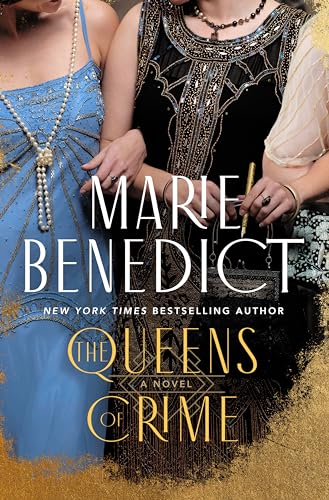
Happy Monday, all! I just finished Queens of Crime by Marie Benedict as a library book because frankly, I am tired of getting burned by Marie Benedict’s amazing ideas with less than great execution (plug here for my local library’s e-book lending program Livebrary!) While my complaint still stands (more on that below), I still found this one slightly better executed than normal.
From the Publisher:
The New York Times bestselling author of The Mystery of Mrs. Christie returns with a thrilling story of Christie’s legendary rival Dorothy Sayers, the race to solve a murder, and the power of friendship among women.
London, 1930. The five greatest women crime writers have banded together to form a secret society with a single goal: to show they are no longer willing to be treated as second-class citizens by their male counterparts in the legendary Detection Club. Led by the formidable Dorothy L. Sayers, the group includes Agatha Christie, Ngaio Marsh, Margery Allingham and Baroness Emma Orczy. They call themselves the Queens of Crime. Their plan? Solve an actual murder, that of a young woman found strangled in a park in France who may have connections leading to the highest levels of the British establishment.
May Daniels, a young English nurse on an excursion to France with her friend, seemed to vanish into thin air as they prepared to board a ferry home. Months later, her body is found in the nearby woods. The murder has all the hallmarks of a locked room mystery for which these authors are famous: how did her killer manage to sneak her body out of a crowded train station without anyone noticing? If, as the police believe, the cause of death is manual strangulation, why is there is an extraordinary amount of blood at the crime scene? What is the meaning of a heartbreaking secret letter seeming to implicate an unnamed paramour? Determined to solve the highly publicized murder, the Queens of Crime embark on their own investigation, discovering they’re stronger together. But soon the killer targets Dorothy Sayers herself, threatening to expose a dark secret in her past that she would do anything to keep hidden.
Inspired by a true story in Sayers’ own life, New York Times bestselling author Marie Benedict brings to life the lengths to which five talented women writers will go to be taken seriously in the male-dominated world of letters as they unpuzzle a mystery torn from the pages of their own novels.
What I loved:
- The Premise. Like normal, I love that Marie Benedict tells less-told stories of fascinating women in history. While she has already visited Agatha Christie’ story in The Mysterious Mrs. Christie, here in Queens of Crime, we get introduced to a whole array of female sleuth writers: Dorothy Sayers of Lord Wimsey fame, the Baroness Emma Orczy who wrote The Scarlet Pimpernel, Ngaio Marsh who wrote of Chief Inspector Alleyn, and Margery Allingham writing the Campion books (and of course the majestic Agatha Christie). These “Queens of Crime” as they were affectionately known during the golden age of detective fiction in the 1920s were of varying ages and backgrounds, but all wrote some of the most famous and formative crime fiction of their time. In Queens of Crime, Benedict has these queens solving a real life murder to prove to their male author colleagues that they belong in Detection Club. While there is no record of the Queens teaming up to solve a murder, the Detection Club is real and all of the Queens were involved at some point. Sayers and Christie both held the presidency tenure at some point in time. I love the idea that these formidable women teamed up to do some good in the world and outclass their male counterparts.
- The “Resolution.” Without spoiling anything by going into too far of detail, solving this murder with the Queens was very satisfying. Not only do they get justice, but they expose a great deal of societal wrongs at the time with the forgotten women post-World War I, when there were too many women for the men left in England. I loved learning about the historical context for where the mystery was set through the mystery, and the anger felt at all of the injustices going on was so satisfied at the end.
What Didn’t Work as Well for me:
- The Characterizations. My biggest complaint about Marie Benedict’s books is that her main characters are never likable. I am not saying that everyone should be likable – a flawed voice can be just as compelling as a Miss Suzie Sunshine. But Benedict takes this too far, and every one of her otherwise strong-seeming female narrators has the most whiny, self-absorbed point of view. I would love to think that Sayers was not a “pick me” girl, but when you have lines from her point of view about, literally, how she is not like those other women, it is hard not to hate her. It is like Benedict does not want to make her characters too perfect lest they seem fake, but instead makes them insufferable.
Conclusion
While Benedict’s characterizations and use of the first person always kill me, Queens of Crime was still an interesting and engaging read despite its narrator. If you love a dash of history, particularly women’s history, and solving a good murder, this is the right book for you. Three waves! Order the hardcover or preorder the soft cover here to have in time for beach weather.
 Books for the Beach